


Commercial Trenchless Sewer Repair Guide
- thetrenchlessguys
- Jul 27
- 5 min read
A failed sewer line beneath a parking lot, restaurant kitchen, medical office, or apartment building can quickly become an operations problem, not just a plumbing problem. This commercial trenchless sewer repair guide explains how facility teams can diagnose underground pipe failures, choose the right repair method, and limit disruption to customers, tenants, staff, and the property itself.
Commercial sewer work carries higher stakes than a typical residential repair. Pipe access may run through finished interiors, loading areas, landscaped grounds, paved drive lanes, or beneath active equipment. The right approach depends on the pipe condition, the line’s depth and diameter, code requirements, and how much downtime the facility can reasonably absorb.
Start With a Complete Sewer Assessment
No repair method should be selected from a surface symptom alone. Slow drains, recurring backups, sewage odors, sinkholes, wet pavement, and frequent calls for drain clearing can all point to a sewer issue, but they do not identify the cause or extent of the damage.
A commercial CCTV sewer inspection provides the needed information. A camera is sent through the line to locate cracks, separated joints, root intrusion, grease buildup, bellies, corrosion, offset connections, and collapsed sections. The inspection should identify pipe material, approximate diameter, depth where known, connection points, and the location of each defect relative to a building feature or access point.
For a larger facility, the inspection should cover more than the section where the backup appeared. A blockage in one branch can expose a broader problem in the main lateral or building sewer. Smoke testing, sewer jetting, and lateral launch camera systems may also be used when the system has multiple branches, hidden cross-connections, or suspected infiltration.
Cleaning comes before many repairs. High-pressure jetting removes grease, scale, roots, and debris so the camera can show the true pipe condition. It also creates a clean surface for lining or coating materials when rehabilitation is the recommended solution.
Commercial Trenchless Sewer Repair Options
Trenchless repair is not one process. The two most common structural methods are cured-in-place pipe lining and pipe bursting. Each solves a different type of problem.
CIPP lining for damaged but serviceable pipes
Cured-in-place pipe, often called CIPP, creates a new pipe inside the existing host pipe. A resin-saturated liner is installed through an access point, inflated or calibrated into position, and cured to form a jointless, corrosion-resistant pipe within the old line.
CIPP is often a strong choice for cracked clay pipe, deteriorated cast iron, root intrusion at joints, minor offsets, and leaks that allow groundwater or soil into the system. It can rehabilitate long runs with limited excavation, which is especially valuable beneath parking lots, slab floors, driveways, landscaping, and occupied commercial spaces.
The trade-off is that lining requires a host pipe that can be cleaned, prepared, and kept open enough to receive the liner. A fully collapsed section, severe sag, or pipe with major loss of alignment may not be a good lining candidate. Because the liner reduces the inside diameter slightly, the contractor should also confirm that the finished diameter remains appropriate for the fixture load and flow requirements of the building.
Branch connections must be reopened after lining when the work includes a main line with active laterals. This is a critical part of commercial work. A repair that restores the main but leaves a tenant connection blocked is not a complete repair.
Pipe bursting for replacement-level failures
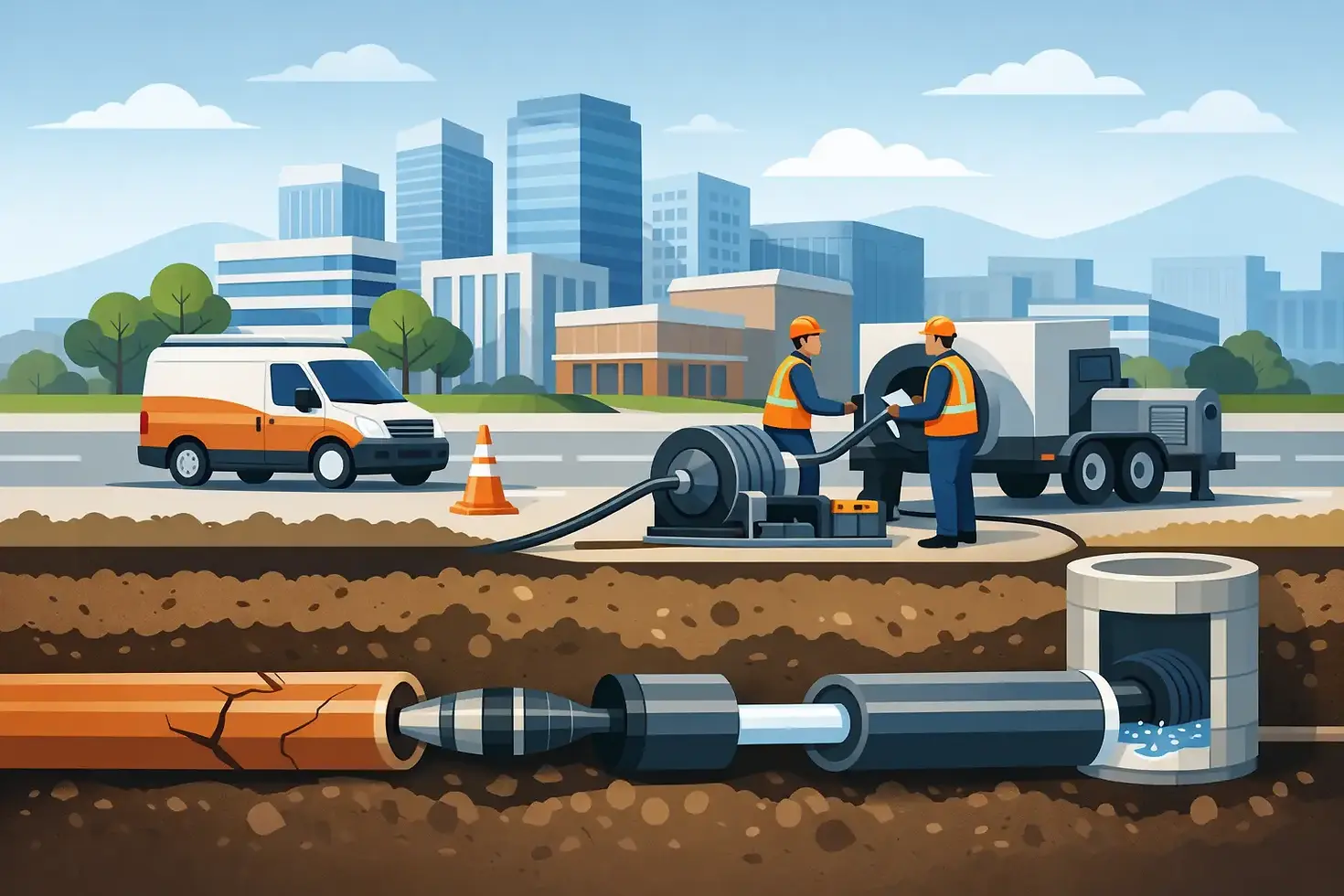
Pipe bursting replaces a failed pipe by pulling a bursting head through the existing line. The head breaks apart the old pipe while drawing a new pipe into place, typically high-density polyethylene. Small entry and exit pits are usually needed, but the work avoids a continuous open trench across the property.
This method is suited to pipe sections that are crushed, severely deteriorated, undersized, or beyond practical rehabilitation with a liner. It can also allow for upsizing in certain conditions, though available clearance, utility conflicts, soil conditions, and local approvals must be reviewed first.
Pipe bursting is more invasive than lining, but it is still far less disruptive than full excavation in many commercial settings. It may be the better long-term answer when the existing pipe has reached the end of its usable life. The decision should be based on inspection evidence, not on a preference for one method over another.
Targeted excavation still has a place
Trenchless technology reduces digging. It does not eliminate excavation on every job. A short excavation may be necessary to repair a collapsed connection, install access, correct a severe belly, expose an unknown utility, or replace a section where grade must be reset.
For commercial owners, the practical goal is not to avoid every shovel of dirt. It is to minimize property disruption while delivering a repair that addresses the underlying failure. A hybrid plan with targeted excavation and trenchless rehabilitation is often the most cost-effective option.
Plan Around Operations, Not Just Pipe Access
A commercial sewer repair plan should account for how the building actually operates. A restaurant may need grease-heavy kitchen lines available before lunch service. A healthcare facility may have strict sanitation and access requirements. An apartment property may need coordinated notice for residents. A manufacturing facility may need work scheduled around production or vehicle traffic.
Ask the contractor how long each phase will take: cleaning, inspection, setup, bypass pumping if required, liner installation or pipe bursting, curing, reinstatement of connections, testing, and site restoration. For active facilities, temporary flow management is often the difference between controlled work and an unplanned shutdown.
Access is another planning factor. Crews may need to work from cleanouts, manholes, roof vents, utility rooms, parking areas, or exterior pits. The preferred access point is not always the closest point to the failure. A good plan balances the pipe path, safe equipment placement, traffic control, tenant access, and protection of finished surfaces.
Ohio weather can also affect scheduling, particularly when exterior access pits, pavement restoration, or wet ground conditions are involved. Trenchless methods can reduce weather-related site impacts, but curing conditions, groundwater, and access still need to be evaluated.
How to Compare Commercial Repair Proposals
The lowest estimate is not always the lowest project cost. A proposal that excludes cleaning, branch reinstatement, bypass pumping, pavement restoration, testing, or permit coordination can create budget surprises later. Commercial decision-makers need a clear scope that identifies exactly what will be repaired and how success will be verified.
When comparing proposals, look for these details:
The inspection findings and the specific line segments included in the scope.
The recommended method, pipe diameter, materials, and expected service life.
Required access points, excavation areas, traffic controls, and restoration responsibilities.
Plans for managing active wastewater flow and maintaining facility operations.
Post-repair camera inspection, testing, documentation, and warranty terms.
Also consider the cost of disruption. Replacing a sewer by open excavation may appear less expensive on paper until the project requires pavement removal, landscape restoration, interior demolition, tenant coordination, lost parking, or extended closure. Trenchless work often provides better total value where surface restoration and downtime are significant cost drivers.
Prevent the Next Emergency
After a repair, establish a maintenance schedule based on the building’s use and the age of its pipe system. Restaurants, multifamily properties, schools, commercial kitchens, and facilities with older cast iron or clay laterals often benefit from routine jetting and periodic camera inspections. Maintenance frequency depends on grease load, roots, pipe material, occupancy, and prior backup history.
Keep camera reports and repair records with the property’s maintenance files. Video, locating data, line maps, and post-repair documentation make future service faster and help owners plan capital improvements before a failure becomes an emergency.
For facilities across Akron and North Central Ohio, The Trenchless Guys Akron brings more than 30 years of underground pipe experience to inspections, cleaning, lining, pipe bursting, and targeted rehabilitation work. The right repair begins with accurate diagnosis, then matches the method to the pipe and the demands of the property.
A commercial sewer problem rarely improves by waiting. Early camera inspection gives property decision-makers time to choose a controlled, minimally invasive repair instead of reacting to a backup when the building can least afford it.


Comments